When a contractor searches “commercial wood grinder capacity,” they are usually trying to answer one of three questions: how many tons per hour do I actually need, what does a real machine deliver on my material, and what does that capacity cost per ton. The spec sheet answers none of these directly.
SHDCN’s own buyer’s guide makes the point plainly: “Always ask for throughput ratings based on your specific material mix. Manufacturers typically rate machines using ideal conditions; real-world performance with wet, green, or contaminated material will differ”. That single sentence is the most valuable capacity guidance on the page—and it is exactly what this article builds around.
The practical capacity bands, calibrated against published industry figures and field data, look like this: compact commercial units: 30–50 TPH; mid-range production machines: 70–120 TPH; high-capacity diesel: 150–200+ TPH on favorable material. Where a machine lands within those bands depends far more on feedstock, screen setup, and uptime than on the horsepower badge on the hood.
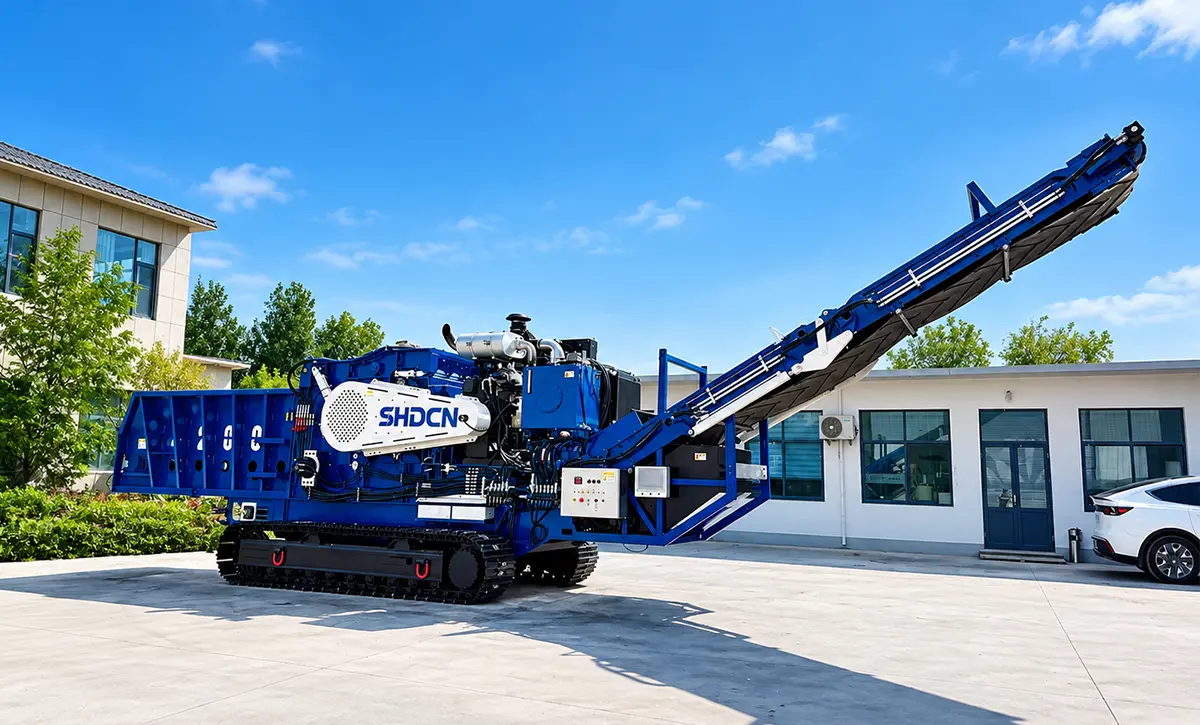
| Model | Engine | Power | Weight | Capacity Positioning |
| DHG 4000 | YCK11480-T300 | 480 HP / 353 kW | 23,500 kg | Compact commercial entry; suited to 30–50 TPH class on green waste, branches, and bark |
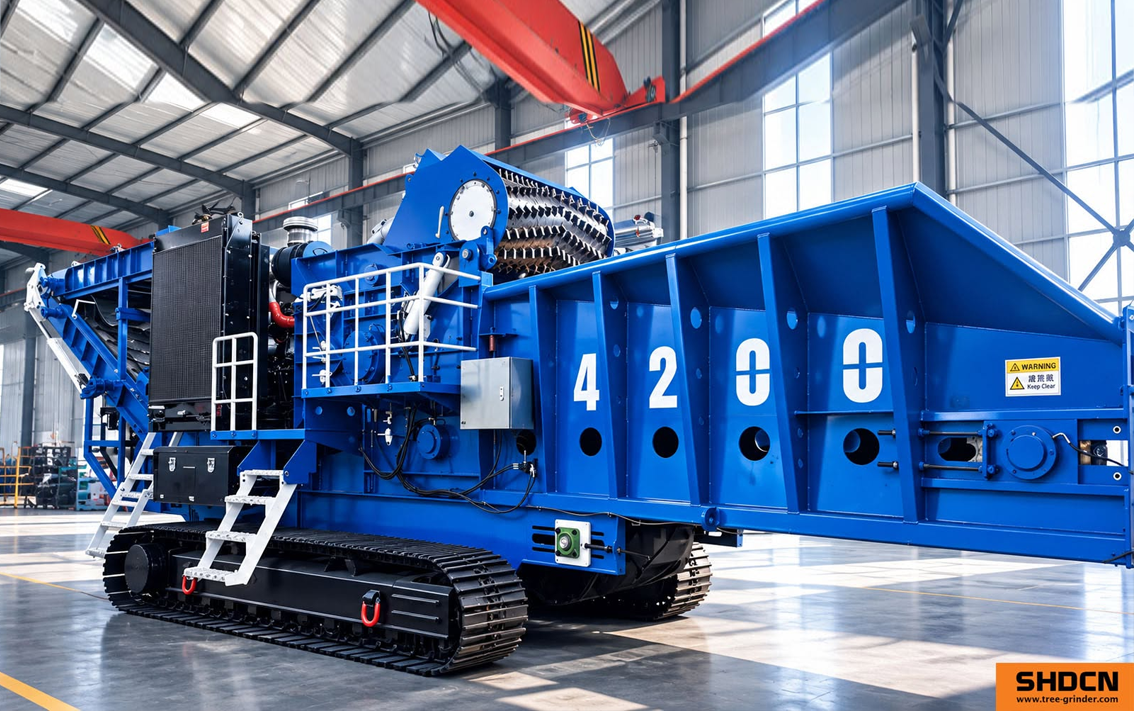
| DHG 4200 | Cummins | 550 HP | 26,500 kg | Mid-size step-up for contractors moving between sites |
| DHG 4600 | CUMMINS QSK-19 | 760 HP / 567 kW | 30,500 kg | High-power tier for higher-volume land clearing and biomass |
| DHG 6800 | CUMMINS QSK38 | 1,080 HP / 790 kW | 36,800 kg | Flagship high-capacity unit for large-scale land clearing and continuous grinding |
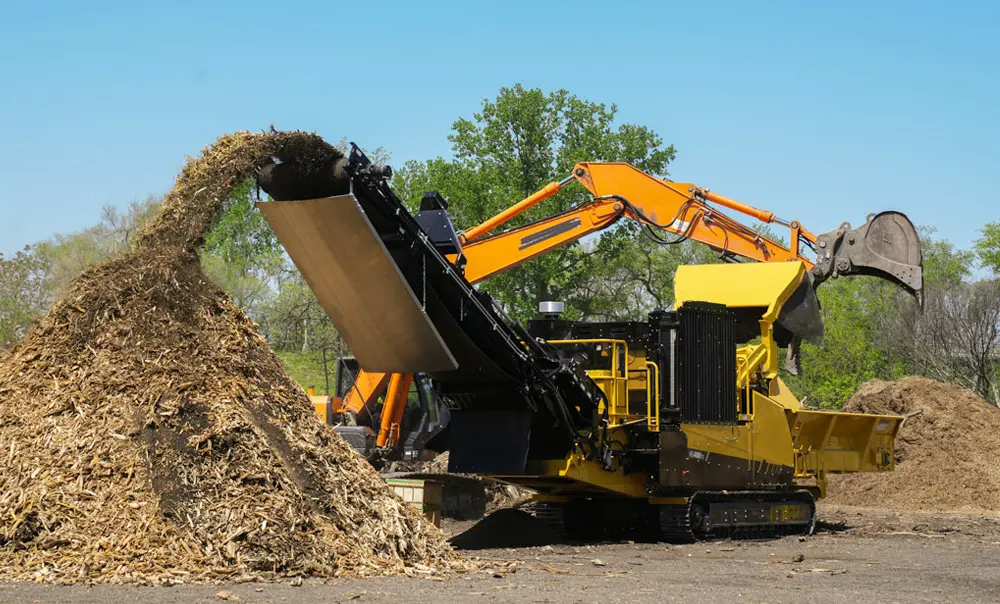
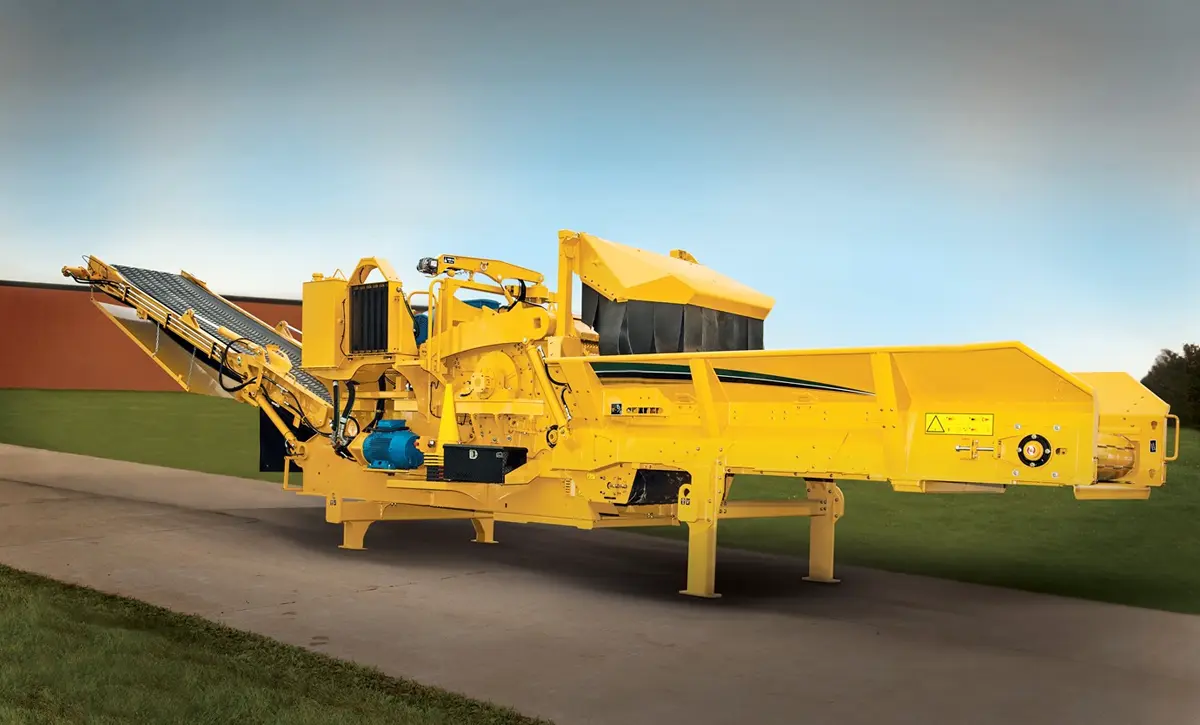
DHG specifications are drawn from SHDCN’s published commercial tree shredder buyer’s guide. The line is designed around primary chipping and secondary crushing, processing material up to 20 cm in diameter without tangling or clogging—a feed-zone architecture that protects capacity on stringy material that would bridge in a conventional mill.
| Model | Main Motor | Weight | Cutting Width / Rotor | Capacity Positioning |
| EG 2110 | 200 kW | 18,100 kg | 1,000 mm cutting width / 1,100 mm rotor | Compact fixed-installation unit for smaller yards |
| EG 4360 | 250 kW | 16,800 kg | — | Mid-range electric for semi-permanent operations |
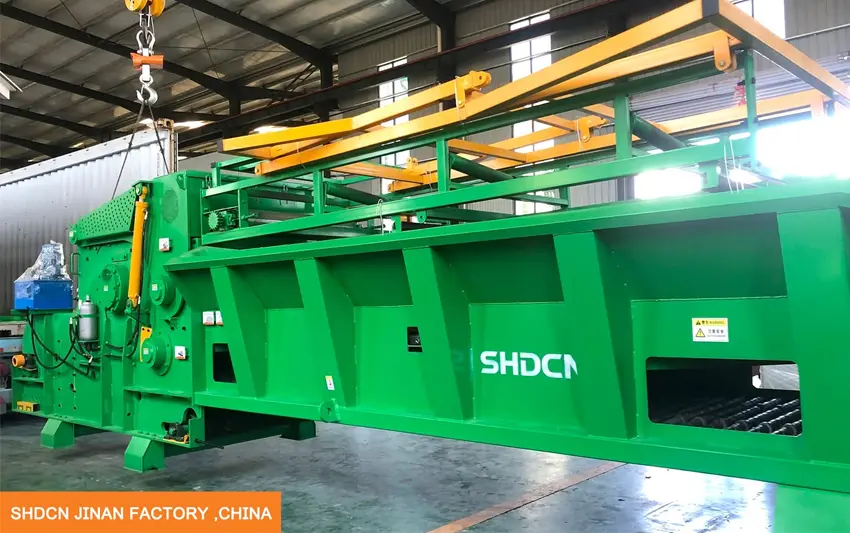
| EG 2113 / 450 kW class | 450 kW | 26,500 kg | 1,400 mm cutting width / 1,300 mm rotor | Maximum-throughput electric platform; largest grinding envelope in the EG line |
The 450 kW electric platform’s capacity logic is cutting envelope × feed consistency × available site power, not engine horsepower. The 1,400 mm cutting width and 1,300 mm rotor define how much material is engaged per revolution. On the high end of the electric line, the EG 6800C pairs a 15% larger screen area wrapping more than 190° around the rotor with an optional dual 500 HP drive, allowing production rates to “surge beyond 200 tons per hour” on the toughest material.
The largest source of capacity disappointment is not the machine—it is the gap between instantaneous maximum and shift-average output. Three factors drive that gap more than any other.
Screen aperture is a direct capacity trade-off. Smaller screen holes produce finer product but restrict throughput; larger holes increase TPH at the cost of coarser output. A machine rated at 200 TPH with a large screen may drop materially when the product specification forces a smaller aperture. This is why “maximum capacity is not the same as normal daily capacity”—the screen size used in the rating is almost never stated in the headline number.
Feedstock condition is the multiplier nobody quotes. Wet, green, contaminated, or stringy material changes real-world throughput substantially. A machine that publishes 200 TPH on clean pallets will not hit 200 TPH on dirty C&D. SHDCN’s DHG feed architecture is designed to protect capacity on the difficult end of that spectrum, but the derating for feedstock condition still applies.
Downtime erases capacity permanently. A grinder running 50 minutes per hour at 180 TPH averages 150 TPH. The same machine running 45 minutes per hour averages 135 TPH—with the identical spec sheet. Industry capacity guidance consistently notes that downtime “quickly reduces both production and profitability”. For a capacity calculation to be useful, it must start from productive minutes per hour, not nameplate TPH.
The right way to select capacity is to work backward from the daily tonnage target rather than forward from the spec sheet.
| Step | What to calculate | Worked example |
| 1. Daily tonnage target | Tons per day your operation must process | 1,200 tons/day |
| 2. Productive hours | Shift length × productive minutes ÷ 60 | 10-hour shift × 50/60 = 8.33 productive hours |
| 3. Required average TPH | Daily tonnage ÷ productive hours | 1,200 ÷ 8.33 = 144 TPH |
| 4. Feedstock derating | Apply a factor for material condition | 15% derating on mixed C&D → required rated capacity ≈ 169 TPH |
| 5. Model match | Select the smallest model whose rated capacity clears step 4 | DHG 6800 class for the top of the diesel range; 450 kW EG for fixed electric duty |
The critical selection principle: a 1,080 HP DHG 6800 is the right answer when daily tonnage demands it and multiple shifts justify the capital. A 480 HP DHG 4000 is the right answer when the objective is commercial-grade output from a compact, road-transportable platform. Buy the smallest model that clears your daily tonnage target with margin for feedstock variability—not the largest model the budget allows.
Capacity only matters in relation to what it costs to produce. Published industry operating-cost benchmarks for an 800 HP class horizontal grinder cluster in the $244–$274 per hour all-in range including fuel, with fuel alone at roughly 25 gal/hr × $4/gal = $100/hr.
The capacity-to-cost conversion is straightforward:
Cost per ton = Hourly operating cost ÷ Actual TPH
At $260/hr** and **130 actual TPH**, cost is **$2.00/ton. At the same hourly cost and 180 actual TPH, cost drops to $1.44/ton**. On the revenue side, a high-production grinder processing **240 TPH at $20/ton in tipping fees generates $4,800 per hour in tipping revenue alone—before fuel, labor, and wear. That arithmetic is why capacity class and uptime discipline are inseparable in ROI calculations: a machine that loses 10 minutes per hour to unplanned downtime has a fundamentally different cost per ton than one that sustains output across the shift.
For biomass and mulch producers, an additional benchmark is useful: third-party grinding research on modified horizontal grinders has reported output in the 25–38 green tons per productive machine hour range at a cost of roughly $4.22 per green ton**, with a machine rate near **$161 per productive machine hour—a concrete anchor for converting capacity into per-ton economics on biomass work.
What is a realistic TPH range for a commercial wood grinder?
Compact commercial units typically cover 30–50 TPH on green waste and pallets. Mid-range production machines cover 70–120 TPH, and high-capacity diesel units reach 150–200+ TPH on favorable material. SHDCN’s DHG line spans 480 HP to 1,080 HP, with the DHG 6800 as the flagship high-capacity diesel unit and the 450 kW EG platform as the largest electric grinding envelope in the SHDCN range.
Which SHDCN model has the highest documented capacity?
On the diesel side, the DHG 6800 with a Cummins QSK38 rated at 1,080 HP / 790 kW is the highest-horsepower unit. On the electric side, the EG 6800C is documented to allow production rates “surge beyond 200 tons per hour”, supported by a 190°+ screen wrap and an optional dual 500 HP drive set-up.
Why does my machine not hit its rated TPH?
Three reasons dominate: the screen aperture used in the rating may be larger than the one your product specification requires; the feedstock may be wetter, greener, or more contaminated than the rating basis; and productive minutes per hour may be lower than assumed due to feed interruptions or maintenance. Rated capacity is an upper bound under specified conditions, not a shift-average guarantee.
How do I calculate the TPH I actually need?
Divide your daily tonnage target by productive hours per shift, then apply a feedstock derating factor. Example: 1,200 tons ÷ 8.33 productive hours = 144 TPH average; a 15% derating for mixed C&D raises the required rated capacity to roughly 169 TPH. Select the smallest DHG or EG model that clears that figure with margin.
FB Page Name : https://www.facebook.com/shdcn
Email: [email protected]
WhatsApp: +86-15315577225