

Building Demolition Materials


● Processing wooden demolition waste
Tree grinders are ideal for recycling wooden components from demolished buildings:
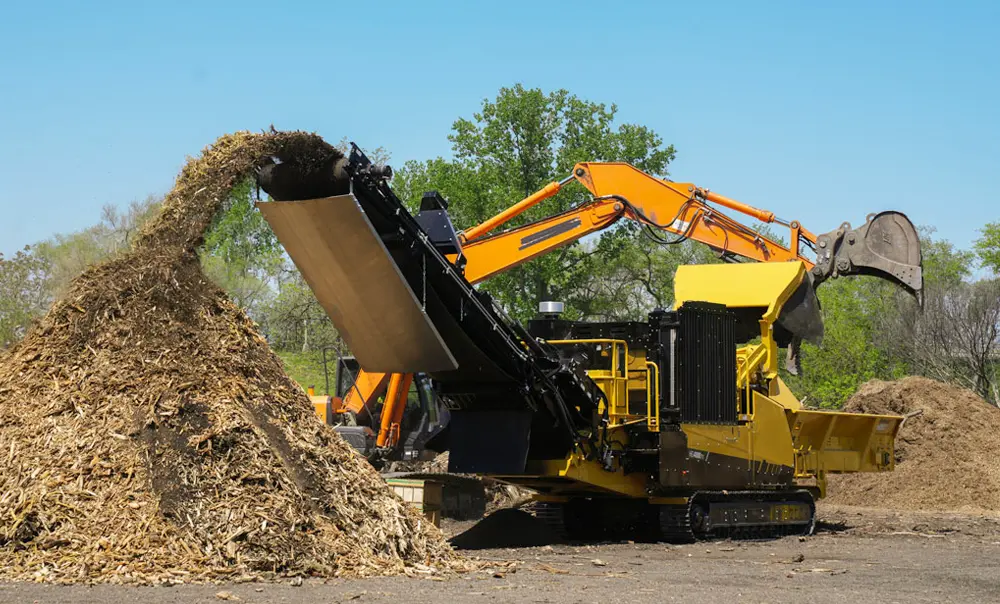
Volume reduction: They break down wooden beams, floorboards, door frames, and roof trusses into small chips or mulch, reducing waste volume by 70-85%. This cuts down on landfill transportation costs and saves valuable landfill space.

Material classification: By adjusting the grinder’s settings, operators can produce different particle sizes for various reuse purposes. For example, fine chips can be used as biomass fuel, while coarser mulch is suitable for landscaping or soil erosion control.
Impurity separation: Many tree grinders are equipped with magnetic separators that remove nails, screws, and other metal debris from wooden waste. This ensures the processed material is clean and safe for downstream applications.

● Handling mixed construction debris
They can process certain mixed demolition materials with pre-sorting:
Wood-concrete composite waste: For materials like wooden formwork attached to concrete, tree grinders can break down the wooden components, leaving concrete chunks to be processed separately. This simplifies the sorting and recycling process.
Drywall and wood mixtures: After removing metal fasteners, tree grinders can grind small amounts of drywall mixed with wood into a fine powder, which can be used as a soil amendment or in low-grade construction materials.
Limitations: Tree grinders are not suitable for processing large amounts of metal, glass, or stone. Proper pre-sorting is necessary to avoid damaging the grinder’s blades and components.
● Producing recycled construction materials
The output from tree grinders can be turned into useful building materials:
Wooden mulch for landscaping: Coarse wood chips from demolition waste are used as mulch in new construction projects, reducing water evaporation, suppressing weeds, and improving soil quality.
Biomass fuel for on-site power: Fine wood chips can be used in on-site biomass boilers to generate heat or electricity for demolition and construction activities, reducing reliance on fossil fuels.
Composite material feedstock: Processed wooden waste can be mixed with plastic or cement to make composite lumber, particleboard, or insulation materials, closing the loop on construction waste recycling.

● Site cleanup and land preparation
Tree grinders help prepare demolition sites for new construction:
Stump and root removal: If the demolition site was previously a wooded area, tree grinders can remove stumps and underground roots quickly, eliminating obstacles for foundation excavation.

Debris clearing: They can grind small trees, shrubs, and brush on the site, turning them into mulch that can be left on-site to improve soil fertility or removed for other uses.
Dust and noise control: Compared to heavy equipment like bulldozers, tree grinders produce less dust and noise, making them suitable for demolition sites in urban areas with strict environmental regulations.