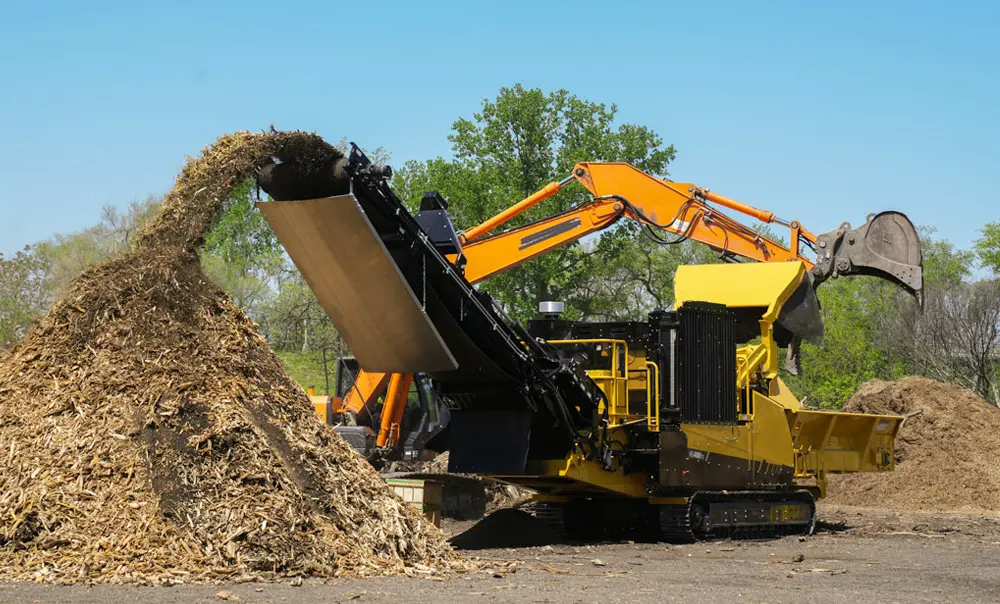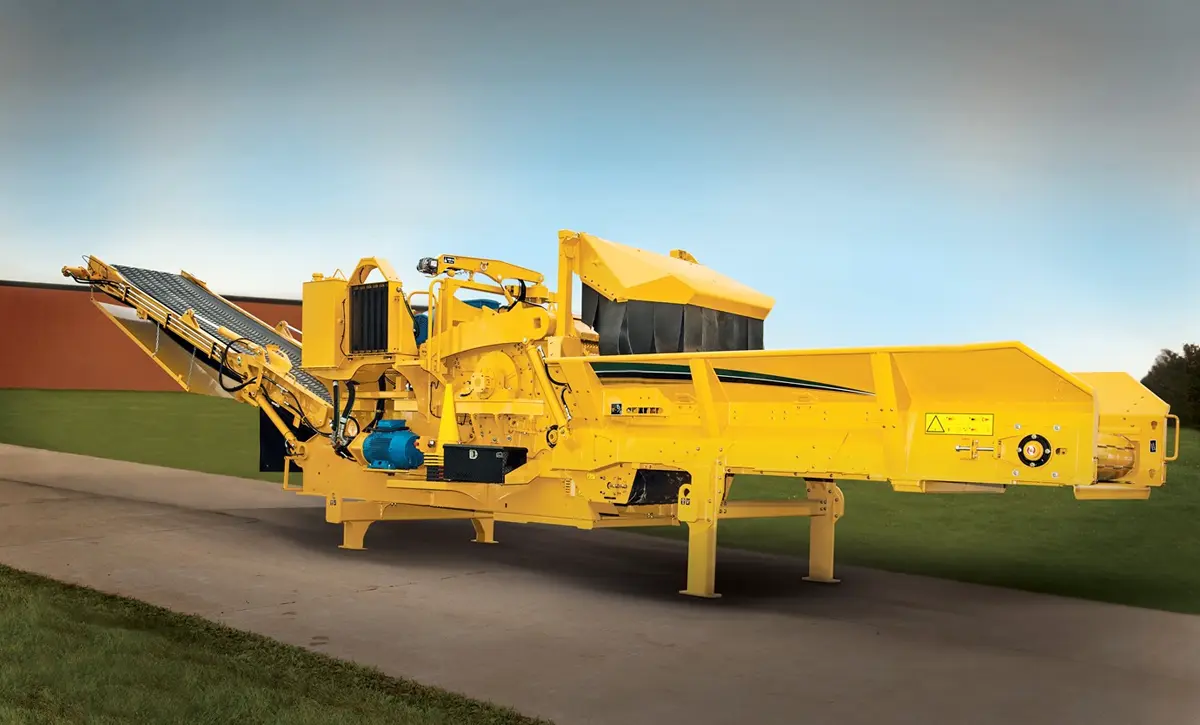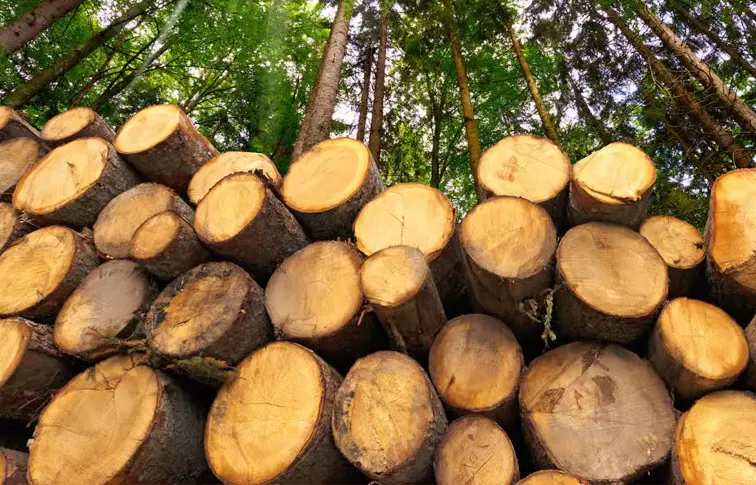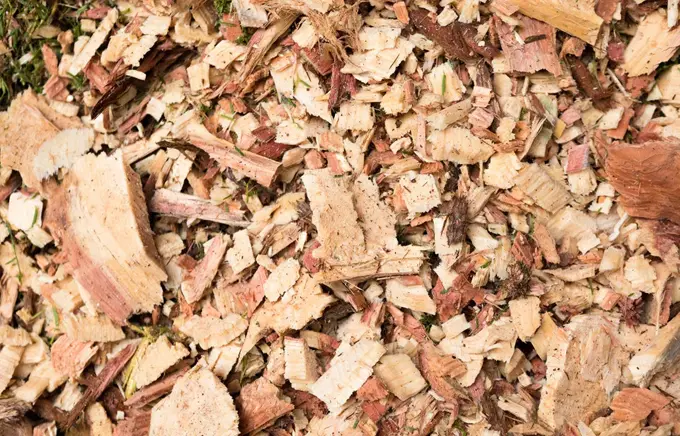
An industrial wood grinder is almost never the constraint in a well-designed wood processing operation—and almost always the constraint in a poorly designed one. The same machine can run at its rated throughput in one yard and struggle to reach half of it in another, without any difference in maintenance quality or operator skill. The variable that explains most of that gap is not the grinder. It is the system the grinder sits inside: how material reaches the feed zone, how consistently the machine is loaded, how downtime is managed, and whether the unit is monitored or merely repaired after failure.
This article takes the system view. It is written for operations already running an industrial wood grinder—or specifying one for a continuous production line—where the question is no longer “which machine” but “why is the machine not delivering what it should.”
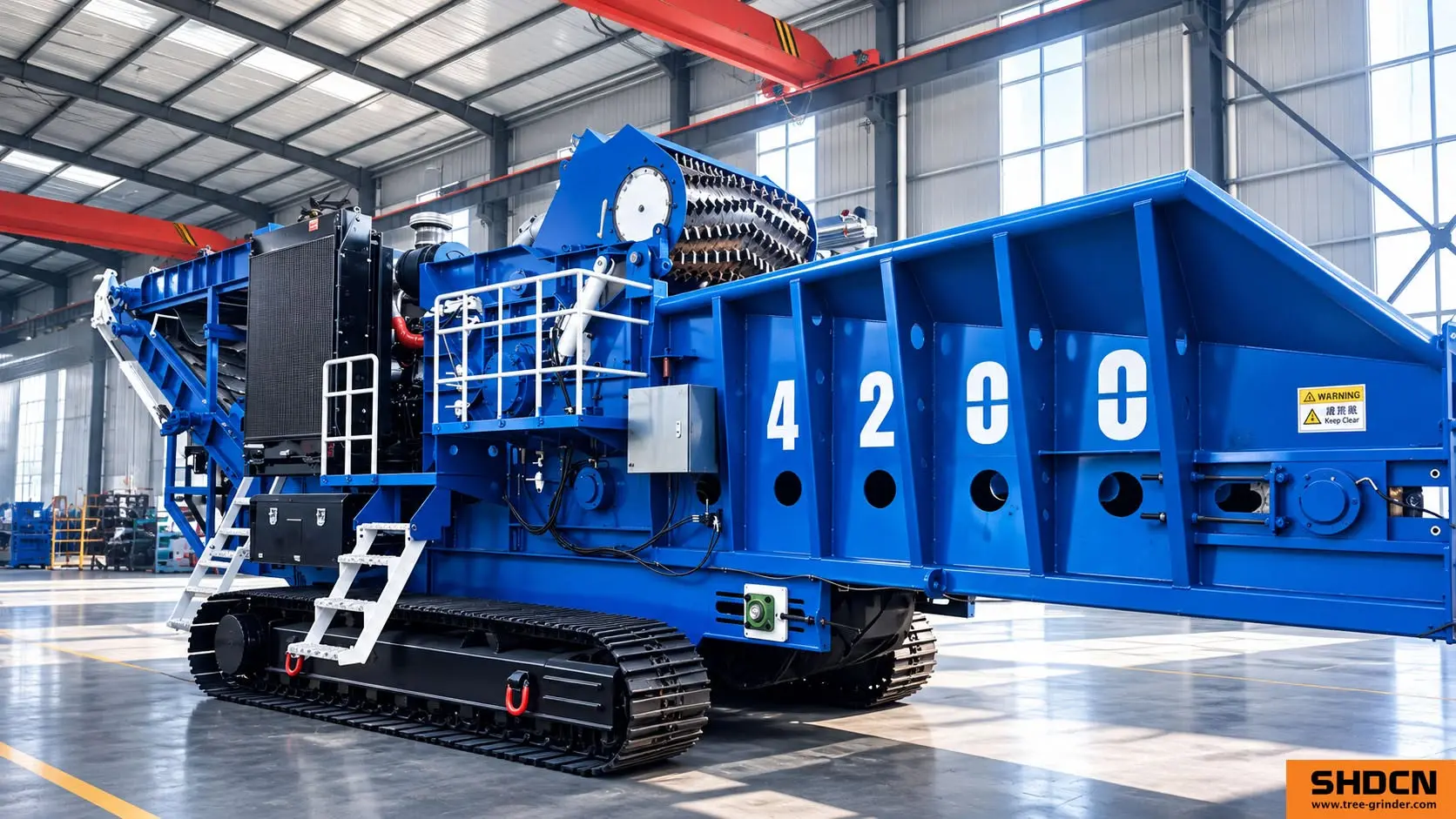
Industrial grinders are frequently evaluated on rotor design, power, and screen configuration. Those matter. But the first place throughput disappears is upstream of all three: at the feed zone.
A horizontal grinder force-feeds material into the grinding chamber at a controlled rate. That control is the source of the horizontal platform’s advantage on clean, uniform feedstock—but it is also the point where stringy, long, or irregular material either flows or bridges. Conventional mill designs can choke on material that wraps, tangles, or forms a mat across the infeed, and every minute spent clearing a bridge is a minute the rotor is not producing.
The design response to this problem is architectural rather than a matter of more horsepower. Industrial platforms increasingly use a two-stage feed-zone logic: primary chipping followed by secondary crushing, with the feed zone configured to process material up to roughly 20 cm in diameter without tangling or clogging. In practice, this means the machine is not asking the rotor to do all the work in a single engagement; the material is progressively reduced in a way that protects flow through the chamber even when the feedstock is not ideal.
For the operator, the implication is practical: if the grinder is routinely slowing down on stringy or long material, the problem may not be the rotor or the screen—it may be that the feed-zone architecture is mismatched to the material mix. Adding power to a machine whose feed zone cannot maintain a steady material column does not recover the lost tons.
Once the feed zone is flowing, the next system variable is uptime—and it is routinely treated as a product specification when it is actually an operating discipline. A grinder’s productive capacity is not its rated tons per hour; it is rated tons per hour multiplied by the fraction of scheduled hours the machine is actually grinding.
The field data is consistent on this point. In biomass front-end operations, grinder uptime has been identified as a structural bottleneck, and the documented response has been advanced control methods and instrumentation rather than simply buying a larger machine—using online monitoring to address downtime and guide plant operations. The lesson transfers directly to wood processing: the machine that spends less time in the garage produces more than the machine with a higher spec sheet that spends more time being repaired.
Three management levers move uptime more than any single component choice:
Wear-part change discipline. Hammers, tips, and screens are consumables, and their remaining life is predictable. Scheduling replacement before failure avoids the unplanned stop that cascades through a production line. A machine designed for reversible hammers and tips extends wear life and reduces the frequency of the change itself—which is uptime gained through component design, not through maintenance heroics.
Contamination strategy. Metal in the feedstock is a leading cause of catastrophic grinder damage. The system-level answer is not “feed cleaner material” as an aspiration; it is detection and separation installed as part of the line. Magnetic head pulleys on discharge conveyors separate ferrous metal after grinding, and impact-absorbing feed systems reduce the damage when contamination does reach the chamber. A grinder without a metal strategy is one stray bolt away from an unplanned rotor repair.
Lubrication and inspection as scheduled work. Centralized lubrication systems convert what is often skipped under production pressure into a routine that is actually performed. The uptime gain is unglamorous but real: bearings and shafts that receive consistent lubrication do not fail on the shift when the line is fully loaded.
The operating benchmark that follows from this is not a percentage target but a ratio: for every eight hours of grinding, roughly one hour should go to cleaning, greasing, and inspection. That hour is not overhead. It is what purchases the next eight productive hours.
The most consequential change in industrial grinding over the past several years is not a mechanical innovation. It is instrumentation.
Industrial grinders increasingly incorporate smart sensors, onboard diagnostics, and programmable logic controllers (PLCs) that allow operators to monitor performance metrics in real time, and manufacturers have adopted telematics for remote monitoring, predictive maintenance, and fleet-level data analytics. In large-scale operations, AI-driven predictive maintenance systems identify early signs of wear or malfunction and have been associated with reductions in unplanned downtime on the order of 15 to 20 percent.
What this means at the machine level is specific. A monitoring system that tracks temperature, humidity, current, and voltage and provides early warnings is not a dashboard for its own sake—it is a mechanism for converting a failure that would stop the line into a maintenance task that can be scheduled between production runs. The relevant comparison is not “monitored versus unmonitored.” It is “monitored machines that generate actionable warnings” versus “machines whose first warning is a breakdown.”-3
The practical selection question for a buyer is therefore not whether a grinder has a screen or an app. It is whether the monitoring is wired to something the operator can act on: early-warning thresholds, fault logging that supports diagnosis, and remote visibility that shortens the time between a symptom appearing and a technician responding.
An industrial wood grinder does not produce “chips” in the abstract. It produces an input to a downstream process—mulch bagging, pellet milling, boiler feed, panel manufacturing—and the grinder’s configuration should be specified backward from that downstream requirement, not forward from available power.
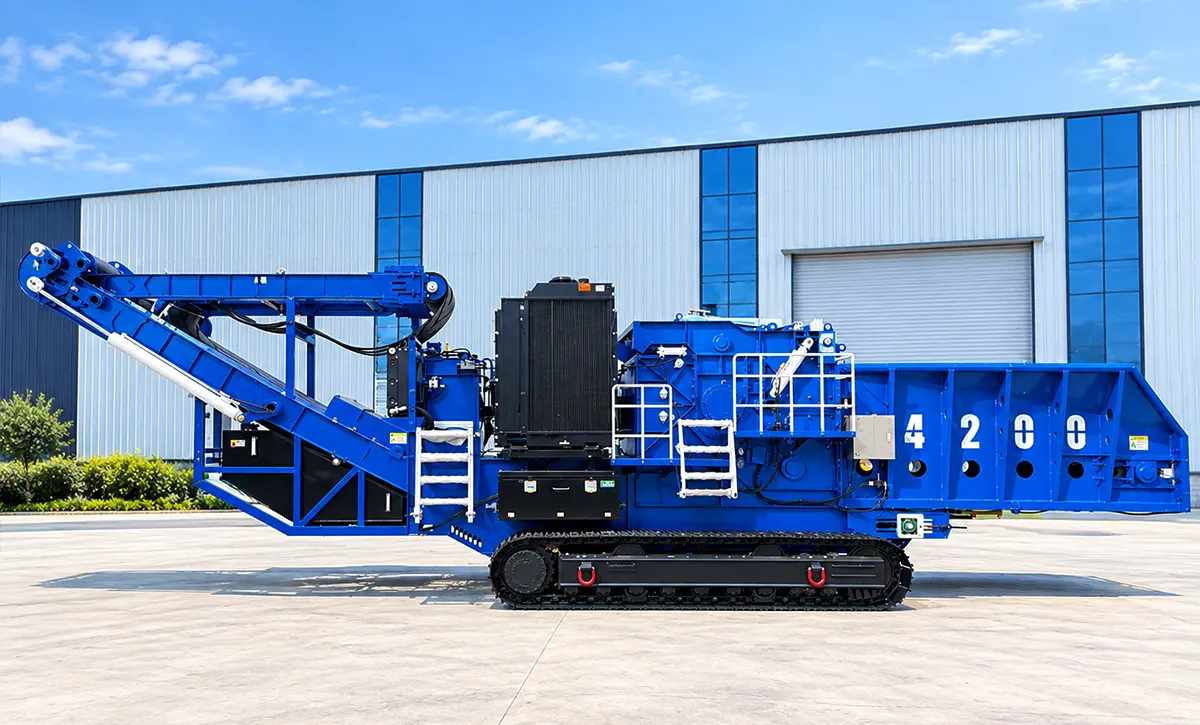
This is where platform choice becomes a system decision rather than a preference. Diesel platforms suit mobile operations and sites without reliable grid power. Electric platforms suit fixed or semi-permanent yards with three-phase power, and they change the capacity logic: output is governed by cutting envelope × feed consistency × available site power, not engine horsepower alone. A 450 kW electric platform with a 1,400 mm cutting width and 1,300 mm rotor defines its capacity through how much material is engaged per revolution rather than through engine displacement.
The integration details that determine whether the machine actually hits the downstream specification include:
Drum and rotor configuration. A chipper drum or knife-cutter setup can be configured to produce output from a fine micro-chip suitable for pellet production up to a standard 3/4-inch chip or larger 2-inch chips, depending on the drum and knife arrangement. The same machine platform can feed different downstream processes only if the drum/rotor is matched to the target specification.
Screen set. Screen geometry is the final control on particle size distribution. A machine ordered with a single screen and operated on a multi-product yard will either under-serve some products or be changed over more often than the schedule allows.
Discharge and handling. Discharge conveyor height, belt design, and metal separation on the discharge all affect whether the grinder’s output can move to the next stage without a bottleneck.
Electrical infrastructure. Soft-start motors reduce line-voltage drop and allow an electric grinder to be rolled in and started without a special foundation—but the site still needs to supply the required voltage, phase, and capacity.
The system-level rule is simple: the grinder is one stage in a chain, and a machine specified in isolation will eventually be re-specified to match the chain it actually feeds.
Once the grinder is understood as a system node rather than a standalone asset, the decision criteria reorder.
Feedstock consistency is a design input, not an excuse. The material mix should determine the feed-zone architecture and the drum/screen configuration before power is discussed. A machine that cannot maintain flow on the actual material mix is the wrong machine regardless of its rated capacity.
Uptime should be evaluated as an operating plan. Ask what the wear-part change interval looks like, how contamination is detected and separated, and what the lubrication schedule requires. A grinder with reversible wear components, centralized lubrication, and a metal strategy is a different uptime proposition from one without them.

Monitoring should be judged by actionability. The value of smart sensors and telematics is realized only when warnings translate into scheduled maintenance. Specify the monitoring, but also specify who acts on it and how quickly.
Configuration should be traced to the downstream product. Drum type, screen set, and discharge handling are not accessories; they are the means by which the grinder meets the specification of the process it feeds.
An industrial wood grinder is a production asset whose output is determined less by its badge than by the system around it. Operations that treat feed zone, uptime discipline, instrumentation, and downstream integration as design variables—rather than as problems to solve after commissioning—are the ones that get the rated tons out of the machine shift after shift. The machine matters. The system is what makes the machine matter.
FB Page Name : https://www.facebook.com/shdcn
Email: [email protected]
WhatsApp: +86-15315577225